At the Harley Street Hair Clinic, we perform specialist Afro hair transplants in London for people with Afro-textured, tightly coiled hair. Afro hair follicles curve beneath the scalp, which makes extraction and implantation far more technically demanding, so this is not a generic procedure. Every Afro hair transplant is carried out by a GMC-registered surgeon experienced in follicle curvature, curl-pattern preservation, keloid risk, and directional placement, using FUE, the minimal-scarring method we specialise in.
See how it works below, or book a consultation for a personalised assessment.
GMC-registered surgeons · Rated 4.8 on Trustpilot
Afro Hair Transplant at a Glance
What Is an Afro Hair Transplant?
An Afro hair transplant is a specialist micro-surgical procedure designed for people with Afro-textured, tightly coiled hair. The hair transplant procedure involves harvesting hair follicles from one area of the scalp and implanting them into the balding section, where they can grow. An Afro hair transplant differs from a standard one due to the unique anatomy of Afro hair follicles. It requires a more dedicated, expert technique that often takes more time, as it is technically more demanding, but the results are just as successful as those of standard hair transplants, provided the right technician performs the job.
Why Afro Hair Requires a Specialist Approach
Hair restoration for Afro-textured hair requires a specialist approach because of the way Afro hair follicles grow. They grow at a curved angle beneath the scalp, which makes extraction and implantation significantly more technically demanding.
As such, an Afro hair transplant, or hair transplant for black hair, does not follow a standard approach – instead, it requires an experienced surgeon with a full understanding of follicle curvature, curl pattern preservation, keloid risk, and directional placement.
Common Causes of Hair Loss in the Afro Hair Community
There are several reasons a person in the Afro hair community may experience hair loss and, in turn, want a hair transplant. These are some of the most common.
- Traction Alopecia: Traction alopecia refers to hair loss caused by pulling of the scalp, usually due to tight hairstyles such as braids, weaves, and extensions. For permanent traction alopecia hair loss, a hair transplant specifically for traction alopecia can restore growth.
- Central Centrifugal Cicatricial Alopecia (CCCA): CCCA is a progressive, scarring form of hair loss common in black women. CCCA hair loss treatment may be a little more difficult, with active scarring affecting surgical suitability. If you have CCCA, it’s important to book a consultation for a full assessment to see if a hair transplant is an option.
- Androgenetic Alopecia: This is the most common cause of hair loss across the board. It’s a genetic type of hair loss that affects men (male pattern baldness) and women (female pattern baldness).
- Chemical Relaxers, Perms, or Harsh Treatments: Harsh treatments like chemical relaxers are popular in the Afro hair community to make the hair more manageable or silky, but they can cause damage to the follicles and lead to hair loss. In cases where the hair follicles have undergone ongoing chemical damage over the years, this hair loss can even be permanent.
- Hormonal Changes: Hormonal changes can affect hair growth. Significant hormonal changes during menopause, pregnancy, and PCOS are significantly linked to hair loss.
Treatment is Available
Remember that no matter the cause of your hair loss, there are treatments available, including a hair transplant for tightly coiled hair, so you can enjoy full, thick hair once more. If you want to know whether an Afro hair transplant is an option, simply book a consultation to speak with one of our hair specialists, as we have the expertise required for patients with afro hair.
How Afro Hair Transplants Work
We use FUE (follicular unit extraction) for Afro hair transplants. It removes individual follicular units with a micro-punch, leaving only minimal, dot-like scarring, which matters for patients who wear their hair short or are at higher risk of keloids. FUE is technically more demanding on Afro hair because of the curved follicles, so it must be done by an experienced surgeon, which is exactly our specialism.
You may come across FUT, an older strip method that removes a section of scalp and leaves a linear scar. We do not use FUT for Afro hair transplants; the table below explains how the two compare and why we focus on FUE.
How FUE Compares to FUT for Afro Hair
| FUE (the method we use) | FUT (comparison only, not offered here) | |
| Harvesting method | Individual follicles extracted with a micro-punch | A strip of scalp is removed and dissected into grafts |
| Scarring | Minimal dot-like scarring, typically not visible | Linear scar that can show with short hair |
| Recovery | Around 1 to 2 weeks | Longer recovery |
| Suits | Shorter hair and patients concerned about scarring or keloids | Not offered at Harley Street Hair Clinic |
The Step-by-Step Process
Step 1 – Consultation & Assessment
Before any procedure, a thorough hair and scalp examination is conducted to assess curl type (4A–4C), follicle density, donor area availability, and overall scalp health.
Step 2 – Why We Use FUE for Afro Hair
FUE extracts individual follicle clusters with a micro-punch, leaving minimal dot-like scarring. On tightly coiled Afro hair it is technically demanding because of the curved follicles, so it is performed only by our experienced surgeons. It is especially suited to patients at higher risk of keloids or who wear their hair short. This is the method we use.
Step 3 – Preparation & Local Anaesthetic
To keep the patient comfortable and free from pain during the procedure, a local anaesthetic is administered. In some cases, a sedative might be offered to help the patient stay relaxed throughout. At this stage, the donor area will also be shaved.
Step 4 – Graft Extraction
The surgeon will extract follicular units from the donor area. This is usually the back and sides of the scalp – essentially, where hair is thickest and densest. The surgeon will take absolute care to follow the curved angle of each follicle to avoid transection, which is critical for an FUE hair transplant for Afro hair.
Step 5 – Graft Preparation
The grafts are then prepared under magnification, inspected for quality, and sorted by graft size. There are between 1 and 4 hairs per unit.
Step 6 – Implantation
Before implanting the grafts, small incisions are created in the recipient area. Then, the grafts are implanted following the natural direction and curl pattern of the patient’s hair. This creates a seamless, organic-looking result.
Step 7 – Recovery & Aftercare
The patient is always given proper post-procedure guidance. Patients can typically return to normal activities, such as work, within 5 to 7 days after surgery.
Hair growth becomes visible after around 4 to 6 months, with full results showing through at 12 to 18 months.
If you have chosen a UK afro Caribbean hair transplant, the recovery and aftercare process will be a lot more straightforward as you will have easier access to follow-up appointments.
Who is a Good Candidate?
Afro hair transplants are suitable for both men and women of black or mixed-race heritage, particularly those with very coiled hair. For example, with 4C hair, a 4C hair transplant is necessary, as the surgeon will have the techniques to follow the distinct curl pattern.
A hair transplant for afro hair is typically suitable for:
- Individuals with traction alopecia who have lost hair along the hairline or temples due to tight styling
- Those with androgenetic (pattern) hair loss affecting the crown, top of the scalp, or hairline
- Patients with hair loss caused by chemical treatments, as long as the follicles remain viable
- Women experiencing female-pattern hair loss or thinning due to hormonal changes
- Patients with a stable donor area, which means sufficient healthy follicles to harvest
If you want to know for certain if surgical hair restoration is right for you, book a free consultation with our clinic today. We specifically offer afro hair transplants in the UK, providing a safe, comfortable environment, stellar follow-up care, and the technical skills required for such a demanding surgery.
Who May Not Be Suitable
Not everyone is suitable for a hair transplant.
Patients with active scarring (such as from CCCA or scarring alopecia) or those without sufficient donor hair may need to try alternative non-surgical hair restoration options. These can be discussed in a consultation with one of our hair specialists. At our clinic, we offer consultations directly with our surgeons so you can speak openly about any concerns you may have. Our expert team is always transparent; if we don’t think a hair transplant is the right step for you, we will be honest about that.
Benefits of an Afro Hair Transplant
- Permanent, natural-looking results: Transplanted hairs stay there permanently, and, when implanted by an experienced surgeon, look effortlessly natural due to the retention of the curl pattern.
- Works for traction alopecia or pattern hair loss: An Afro hair transplant is a good option for traction alopecia and male/female pattern hair loss – two of the most common types of hair loss in the Afro hair community.
- Performed by experienced surgeons: As an Afro hair transplant requires such technical precision, they are always performed by experienced surgeons who give fantastic results. It is not a generic procedure.
- Minimal downtime: Patients can typically return to their normal activities within one to two weeks.
- Boosts confidence: An Afro hair transplant is an enormous confidence booster, as hair plays a big role in how people view themselves. This has a giant effect on the rest of a person’s life, too.
- Saves time: An Afro hair transplant makes a great alternative option to daily camouflage like wigs and extensions, which take a lot of time.
- Can be combined with non-surgical options: For boosted results, an Afro hair transplant can be combined with effective non-surgical options, such as PRP (platelet-rich plasma therapy), hair loss medications, or microneedling.
- A one-day procedure: In the majority of cases, an Afro male hair transplant or black female hair transplant can be completed in a single day.
What to Expect on the Day
The surgeon makes the day of the hair transplant surgery as comfortable and smooth for you, the patient, as possible. Here’s what to expect at each step.
1. Arrival and Preparation
Once the patient arrives, the surgeon conducts a thorough scalp assessment. This involves marking the hairline. After this, a local anaesthetic is administered to the scalp, so the patient doesn’t feel any pain during the surgery.
2. A 4-8 Hour Process
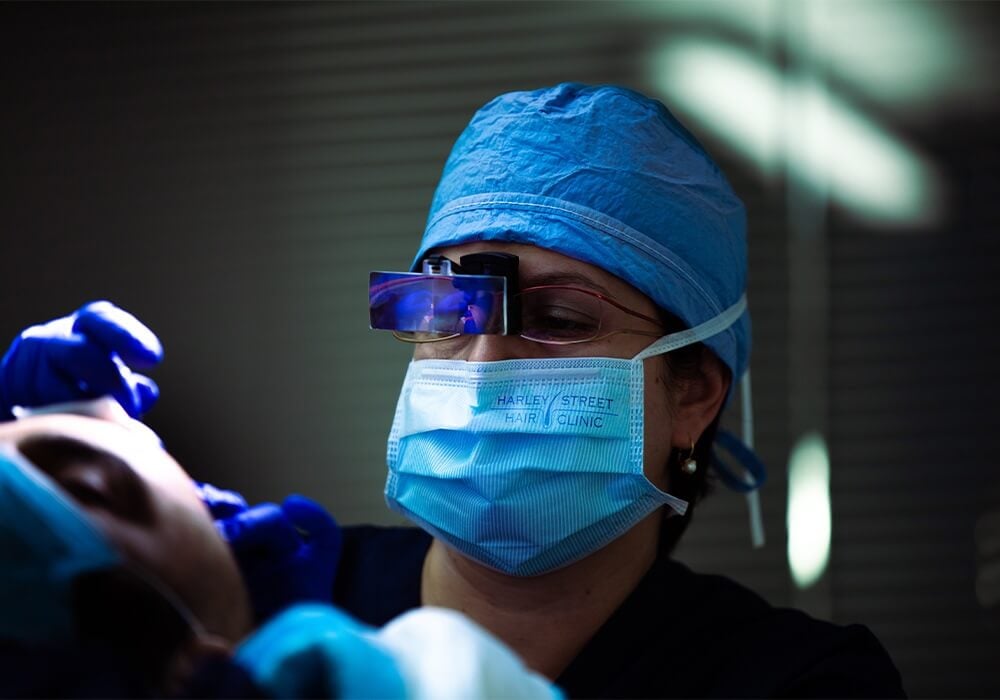
The procedure itself, which involves the surgeon harvesting and implanting hair follicles, should take between 4 and 8 hours, depending on the number of grafts needed.
3. Ongoing Comfort
While patients may feel mild discomfort, the local anaesthetic ensures the procedure is not painful. Plus, refreshments and breaks are provided throughout the day.
4. Post-procedure Review and Aftercare
After the procedure, the surgeon gives a thorough post-procedure review. An aftercare pack is also provided, typically including a specialist shampoo, post-op medication, and a moisturising spray.
Recovery Timeline of an Afro Caribbean Hair Transplant
Here’s what to expect following the procedure.
- Days 1-3: Mild swelling and redness. It’s important to avoid touching the grafts at this stage.
- Days 5-14: Scabs begin to form and shed on the scalp, which is normal. There may also be some shock shedding, which is typical and isn’t anything to worry about.
- Months 1-3: This is the resting phase that the newly implanted hairs go through. There is minimal visible growth during these months.
- Months 4-6: This is when most patients notice new hair emerging in the transplanted areas.
- Months 9-18: Between months 9 and 18, full results become visible. The hair thickens, and the curl pattern fully develops.
Afro Hair Transplant Aftercare
After the hair restoration procedure for African Caribbean hair, the surgeon provides the patient with a full aftercare package. This includes:
- Written post-op care instructions
- Specialist shampoo
- Saline spray
- Access to a dedicated aftercare support line
Patients will be advised to avoid chemical relaxers or heat treatments for at least 6 months post-procedure.
Afro Hair Transplant Cost in London
The price varies significantly depending on the specific case and the number of grafts. Typically, Afro hair transplants range in cost from £2,000 to £15,000. If you want a closer idea of what it will cost you, try the graft calculator. For precise pricing, request a personalised quote via a consultation, where a hair specialist will consider all factors to provide an accurate cost estimate.
GMC-registered surgeons · Rated 4.8 on Trustpilot
Factors that Affect Afro Hair Transplant Cost
Number of grafts: This correlates directly with the degree of hair loss. The more hair transplantation is required, the more grafts are needed – in turn, it will be more expensive.
Complexity of hair loss pattern: The more complex the hair loss pattern, the more expensive the procedure will be.
Surgeon experience: Choosing an experienced surgeon at a highly reputable clinic will mean paying more but getting a better result. It is technically demanding, so it is absolutely critical to only have it performed by an experienced team.
Location of the Clinic: Choosing an afro hair transplant in London may cost you more, but typically, the best surgeons in the world operate in sought-after locations like this.
Finance Options for Afro Hair Transplants
You don’t have to let the upfront cost of a hair transplant put you off getting the procedure that could completely lift your confidence. At Harley Street Hair Clinic, we offer financing options to help you spread the high cost of the procedure. Check out our finance options here.
Results: What to Expect
The results of any hair transplant surgery take time to show through. The first transplanted hairs begin to grow naturally in the treated areas after around 4 to 6 months. Then, there is more visible improvement over the next 9 to 12 months, at which stage the new hairs grow through thicker and more mature.
The final results, however, appear around 12 to 18 months, by which stage you can see full curl development. From here, the results are 100% permanent – the transplanted hair will continue to grow for life.
If you want an idea of exactly how a hair transplant looks, view our before & after gallery.
General Afro Hair Transplants FAQs
Yes, but it requires a surgeon with specific experience in Afro-textured hair. The tightly coiled structure and curved follicles make extraction more demanding, so choosing an experienced specialist is essential.
Good candidates include people with traction alopecia, androgenetic hair loss, or thinning from chemical treatments, provided they have a sufficient donor area. Those with active scarring conditions such as CCCA may not be suitable, a consultation confirms this.
Yes. The transplanted follicles are taken from donor areas genetically resistant to hair loss, so the results are permanent. Medication such as Minoxidil can help manage ongoing natural hair loss around the transplanted area.
Typically £2,000 to £15,000, depending on the extent of hair loss and the number of grafts. A personalised quote is provided after consultation.
Yes. Chemical relaxers affect the hair shaft rather than the follicle, so a transplant is still possible. Avoid chemical treatments for at least 6 months after your procedure.
Initial hair growth typically appears between 4 and 6 months. Full results, including the development of your natural curl pattern, are usually visible at 12–18 months post-procedure.
Procedure Afro Hair Transplant FAQs
We use FUE for Afro hair transplants. It leaves minimal, dot-like scarring rather than the linear scar of the older FUT strip method, which matters for patients who wear their hair short or are at higher risk of keloids.
The procedure is performed under local anaesthetic, so you should not feel pain. Some mild discomfort during the initial numbing is normal, and any soreness afterwards is usually managed with standard pain relief.
Most Afro hair transplants are completed in a single day, typically 4 to 8 hours depending on the number of grafts.
Most people return to normal activities within 5 to 7 days, with strenuous exercise avoided for at least a week. You receive a full aftercare guide and access to post-operative support.
Temporary swelling, redness, numbness, and itching at the graft site are common and settle within a few days; anti-inflammatory medication is provided. Patients with Afro-textured skin should be aware of a slightly elevated risk of keloid scarring, which is discussed at consultation.
Yes. Transplanted hair keeps the genetic characteristics of the donor follicle, including its curl pattern, so it curls naturally to match your existing hair as it grows.
Most patients achieve their result from a single procedure, though those with extensive or progressive loss may benefit from a follow-up. Non-surgical options such as Minoxidil can help preserve and extend results.
Book a Consultation for an Afro Hair Transplant Today
GMC-registered surgeons · Rated 4.8 on Trustpilot
If you have tightly coiled Afro hair and have experienced hair loss, a transplant gives you the opportunity to regrow a full head of thick hair – for life.
It’s a permanent option that can help your confidence soar. At Harley Street Hair Clinic, we have highly trained surgeons with extensive experience in the technical procedure of transplanting Afro hair. With us, you’ll experience a comfortable procedure and natural, lasting results.
For more information about the process, costs, financing options, or whether you are a suitable candidate, do not hesitate to contact our friendly, expert team today.
Start your transformation today
Book your consultation online with one of the world’s leading hair replacement specialists and take the first step towards your new look.