

Minoxidil for Hair Loss
Minoxidil is an over-the-counter vasodilator medication used to treat androgenetic alopecia in both men and women. It’s available as both a topical treatment and an oral tablet, and is available in the UK under the brand name Regaine.
It is a highly popular treatment and is even the second most recommended hair loss treatment by specialists around the world, thanks to the well-documented minoxidil results. While it cannot cure baldness, it’s effective at slowing down hair fallout and stimulating new growth in early to mid-stage hair loss.
It’s a safe, effective medication that has been clinically studied since the 1980s and, unlike some other medications, works well for both men and women alike.
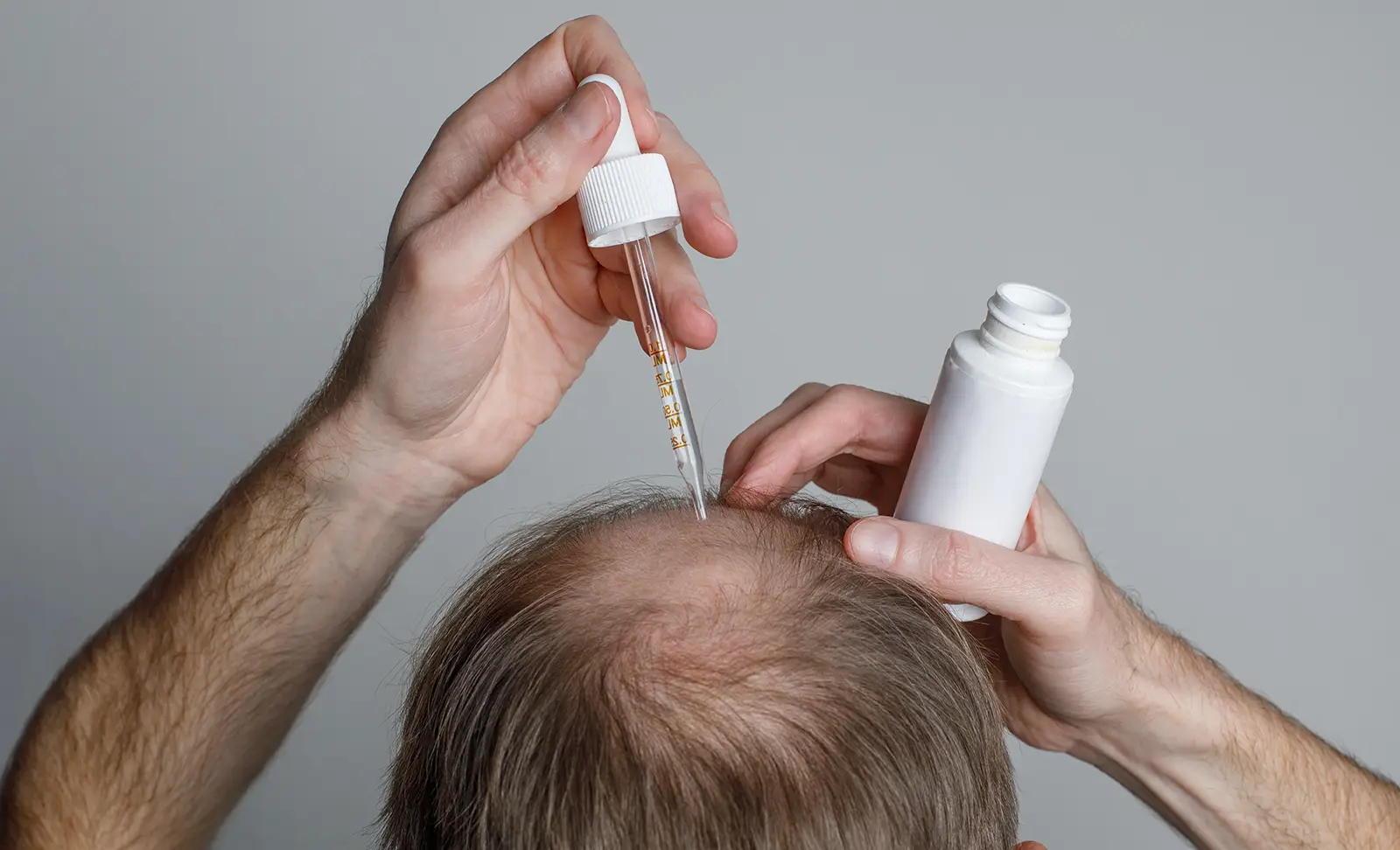
What Is Minoxidil?
Minoxidil is a vasodilator medication that can be taken either orally or topically. Originally developed as an antihypertensive in the 1970s, it was later licensed for hair loss after hair growth was observed as a side effect. Nowadays, it’s commonly sold under the brand names Regaine in the UK and Rogaine in the US.
As a vasodilator, it boosts blood flow to the scalp, helping deliver more nutrients to the hair follicles. As a result, healthier, denser hair can grow.
Due to its hair-boosting effects, Minoxidil is primarily used to treat androgenetic alopecia, but it can also be used for other causes of hair loss, including alopecia areata, telogen effluvium, and traction alopecia, as well as for beard/eyebrow growth.
Topical Minoxidil comes in several forms, including foam, spray, dropper, and shampoo. Oral Minoxidil is taken as tablets and requires a private prescription.
How Does Minoxidil Work?
Minoxidil for hair loss works as a vasodilator, meaning it widens the blood vessels in the scalp, allowing more blood, oxygen, and nutrients to reach the hair follicles. As a result, the hair growth cycle (the anagen phase) is extended, allowing for increased growth and the reversal of miniaturisation.
Keep in mind that the exact mechanism of oral or topical Minoxidil is not yet fully understood; however, the vasodilation theory is widely accepted and is supported by clinical evidence.
Does Minoxidil Work?
Yes – it works, and it has been proven in several clinical trials, as well as a ton of anecdotal evidence from individuals who have used minoxidil for their own hair restoration goals.
The results can be seen in several clinical trials.
- A randomised clinical trial of 5% topical minoxidil vs 2% topical minoxidil vs placebo, looking at minoxidil for men, results showing that the 5% topical treatment led to significantly more hair coverage.
- Several clinical trials are looking at minoxidil for women. A meta-analysis of these studies shows that 2% of minoxidil solution increased hair density by about 12.4 hairs per cm2.
- A randomised placebo-controlled study on 48 men using 3% minoxidil on the beard, results showing improvement in facial hair density compared to men taking a placebo.
Does Minoxidil Work?
Yes – it works, and it has been proven in several clinical trials, as well as a ton of anecdotal evidence from individuals who have used minoxidil for their own hair restoration goals.
The results can be seen in several clinical trials.
- A randomised clinical trial of 5% topical minoxidil vs 2% topical minoxidil vs placebo, looking at minoxidil for men, results showing that the 5% topical treatment led to significantly more hair coverage.
- Several clinical trials are looking at minoxidil for women. A meta-analysis of these studies shows that 2% of minoxidil solution increased hair density by about 12.4 hairs per cm2.
- A randomised placebo-controlled study on 48 men using 3% minoxidil on the beard, results showing improvement in facial hair density compared to men taking a placebo.
Does Minoxidil Work for Men?
Yes, minoxidil for men is a highly recommended treatment, particularly for those with male pattern baldness, which affects more than half of all men by the time they reach 50 years old. The effectiveness of minoxidil results has been proven over and over, with one clinical trial from 2008 showing that 5% topical minoxidil led to 45% more hair growth in 48 weeks.
Does Minoxidil Work for Women?
Minoxidil has also been shown to be effective for treating female pattern baldness. While there has been more research on Minoxidil for men, several clinical trials have shown increased hair density in women using 2% Minoxidil, as evidenced above.
Types of Minoxidil: Foam, Solution, Oral, and Shampoo
There are several ways to take Minoxidil.
- Minoxidil Foam: This is a common form of topical Minoxidil. It’s the most popular option because it is easy to apply and contains no propylene glycol.
- Oral Minoxidil: Minoxidil tablets are available only by prescription. This can be good for patients with pets, as Minoxidil is toxic to cats and dogs.
- Minoxidil Solution: This involves using a dropper or spray and offers the fastest absorption.
- Minoxidil Shampoo: Evidence on Minoxidil shampoo is limited. It’s generally recommended to use a product that stays on the scalp for some time (rather than washing out).
Minoxidil 2% vs 5%: Which Strength Is Right for You?
2%: 2% Minoxidil is well tolerated and is the standard for women. It’s a good starting point if you’re trying Minoxidil for the first time.
5%: 5% is considered more effective, but it carries a higher risk of side effects. Most women should stick to 2%, but many men find 5% Minoxidil leads to better results.
Minoxidil Results: What to Expect and When
It’s common for people new to using Minoxidil to give up in the early days because they do not see immediate results. This is generally a mistake, as Minoxidil results take time to show. So, how long does Minoxidil take to work? Here’s what to expect at each stage.
Weeks 1-8: There are no visible results at this stage. You might experience Minoxidil hair shedding, which is completely normal and temporary.
Months 2-3: The first fine hairs emerge, but they are hard to spot.
Months 4-6: At this stage, there is more visible density on the scalp. You might notice more visible regrowth around the crown and hairline.
Months 9-12: This is when full results start to show through, with thicker hair visible from 12 months onwards.
Keep in mind that continued use is necessary to maintain results!
Want to see in-person examples of hair restoration results? Head to our before & after gallery.
How to Use Minoxidil
Learning how to apply Minoxidil is pretty straightforward.
Of course, before these steps, you’ll need to purchase the right Minoxidil. You’ll need to choose the right Minoxidil dosage – 2% is a sensible starting dose.
Once you have your topical Minoxidil, follow these steps for application.
Step 1: Ensure the scalp is clean and dry before application.
Step 2: Apply 1ml of solution or half a capful of foam directly to the areas of thinning.
Step 3: Gently massage in, do not rinse.
Step 4: Allow to dry fully before bed (at least 2 hours).
Step 5: Wash hands thoroughly after every application.
Doing this twice daily is the standard recommendation, although some patients may be advised to only apply once per day. Remember that you must use Minoxidil consistently for results to stick around; if you stop taking it, results reverse within 3 to 6 months.
Minoxidil Side Effects and Safety
Minoxidil is generally very well tolerated by most people. However, there are some side effects to be aware of.
Common Side Effects:
- Scalp irritation
- Itching
- Redness
- Hair shedding (temporary during the first 2–8 weeks)
- Unwanted facial or body hair growth (hypertrichosis, more common with 5% and oral forms).
Less Common Side Effects:
- Allergic contact dermatitis
- Changes in hair colour or texture
- Dizziness
- Tachycardia
If you are worried about any of these symptoms, contact your doctor before use. If you experience any of them, particularly the less common ones like dizziness or tachycardia, speak to your GP.
Oral Minoxidil Side Effects: Oral Minoxidil side effects differ from topical side effects. For example, oral tablets are more likely to cause systemic hypertrichosis, fluid retention, and headaches, so it should only ever be taken under medical supervision.
Drug Interactions: There are some drug interactions to be aware of, including Benadryl, Xanax, and Cyclosporine, so speak to your doctor before taking Minoxidil if you already take one of these drugs.
You might also wonder, is Minoxidil safe for pregnant women? The answer is no – women who are either pregnant or breastfeeding should not take Minoxidil, as it poses risks like foetal malformations.
It’s also worth noting that topical Minoxidil is toxic to cats and dogs, so be aware if you have pets and always keep the product away from them.
How to Reduce Minoxidil Side Effects
The good news is that there are ways to reduce Minoxidil side effects, such as:
- Only taking the recommended dose
- Washing hands after application
- Applying only to the affected areas
- Always checking expiry date (and not using out-of-date Minoxidil)
Minoxidil vs Finasteride vs Dutasteride
Minoxidil is a different hair-loss medication from Finasteride and Dutasteride. Each has its own mechanism of action. Here’s what makes each one distinct.
| How it Works | Who it Is For | Effectiveness | Cost | How to Take It | Potential Side Effects | Availability | Potency | |
| Minoxidil | As a vasodilator. It widens the blood vessels, delivering more oxygen and nutrients to the hair follicles. | Minoxidil is for men and women. | Studies show Minoxidil is highly effective, especially when using the higher strength of 5%. | £40–£70 for a three-month supply. | Topically: apply to the scalp once or twice per day. Also available in tablet form. | Scalp irritation, unwanted hair growth, fluid retention, and heart palpitations. | Over the counter from online and in-person pharmacies. | Available as 2% or 5%. 2% is recommended for beginners, but 5% may be more effective. |
| Finasteride | A 5-alpha reductase inhibitor. It blocks testosterone from converting into DHT, a hormone that causes hair loss. | Men only. | Studies show Finasteride increases hair count compared with those taking a placebo. | £14+ for a month’s supply. | Taken orally once per day, with or without food. | Low libido, mood changes (anxiety and depression), breast changes, and erectile dysfunction. | Available on the NHS only for enlarged prostates. A private prescription is required for hair loss. | Typically supplied as 1mg tablets. |
| Dutasteride | Like Finasteride, it blocks the production of DHT, but it is more potent. | Men only. | Dutasteride is even more effective than Finasteride, blocking more DHT and leading to a higher hair count. | £15+ for a month’s supply. | Taken orally once per day, with or without food. | Low libido, mood changes (anxiety and depression), breast changes, and erectile dysfunction. | Available via private prescription only. | More potent than Finasteride, reducing DHT by over 95% with a 0.5mg dose. |
Under doctors’ prescriptions, we can supply high-quality Minoxidil and Finasteride, as well as Minoxidil and Dutasteride, compounded and customised to the individual to help achieve the best possible results.
Alternatives to Minoxidil
If you haven’t responded well to Minoxidil, there are other hair restoration treatments available that we can help you with – booking a consultation will put you on the path to finding the right treatment for your hair. Here are some options.
- Finasteride and Dutasteride: Hair loss medications that block DHT. These are used by men who have experienced androgenetic alopecia. They can even be used alongside Minoxidil (although you should only use Finasteride or Dutasteride – not both).
- Adjunct Therapies: There has been evidence showing that adjunct therapies like PRP (platelet-rich plasma therapy), LLLT (low-level laser therapy), and microneedling can help enhance Minoxidil results.
- Hair Transplant: A FUE hair transplant is an option for those who have already experienced significant hair loss. It’s not about preventing ongoing loss; instead, it’s about replacing lost hair. Minoxidil can be used after a hair transplant to protect the surrounding native hair.
If you are unsure about the right hair restoration option for you, the HS Hair Clinic team can help you.
Frequently Asked Questions About Minoxidil
General FAQs
It is an over-the-counter vasodilator medication used to treat androgenetic alopecia in men and women. It comes in both oral and topical forms and works by increasing the blood flow to the hair follicles, which in turn stimulates fresh growth.
It is primarily for men or women experiencing androgenetic alopecia. There are different product types all sold under the brand name Regaine – for example, there’s Regaine for women and Regaine for men.
5% minoxidil costs between £15 and £25 for a 60ml bottle, which is meant to last one month. However, you can get annual plans or bundles where you pay a lower overall price.
Generally, no – minoxidil is not available on the NHS. As hair loss is considered a cosmetic issue, you will have to pay privately for the medication. You can access minoxidil over the counter at most UK pharmacies, without a prescription.
Yes, topical Minoxidil is safe for women. The 2% solution is generally tolerated best by women, although 5% Minoxidil is also available.
No, you do not need a prescription for minoxidil. You can purchase minoxidil under the popular brand Regaine over the counter from most pharmacies.
Usage FAQs
How you apply Minoxidil depends on the type of solution you have. If using foam Minoxidil, apply by massaging the foam into your fingers and then applying it to thinning areas. If using a topical solution, apply with a dropper or spray to affected areas.
Minoxidil lasts as long as you continue using it. It is recommended to use Minoxidil once or twice daily to maintain results.
Stopping taking Minoxidil will cause any hair growth results to reverse. To maintain any new growth, you must continue using Minoxidil indefinitely. At the same time, there are no medical concerns associated with stopping taking Minoxidil.
Yes, you can take Minoxidil and Finasteride Together. In fact, it’s highly recommended by hair specialists, as both promote growth through different mechanisms. While Minoxidil boosts blood flow to the scalp, Finasteride blocks the production of DHT, a hormone that causes hair follicle miniaturisation.
Start your transformation today
Book your consultation online with one of the world’s leading hair replacement specialists and take the first step towards your new look.