Gender-Affirming Hair Restoration: An Integrated Surgical Approach
4 minute read
Hairline contour, position, and density are among the features that most shape how a face is read as masculine or feminine. For transfeminine individuals, addressing androgenetic hair loss and a masculine forehead shape is central to facial harmony, and modern gender-affirming care approaches the two together rather than in isolation.
Male And Female Hairlines Are Different
Feminising a hairline starts with understanding how masculine and feminine hairlines differ in structure.
Feminine hairline. Sits lower, roughly 5.5 to 6 centimetres above the mid-brow, forming a soft, rounded, inverted-U or oval shape. The frontotemporal corners are filled and rounded, curving smoothly into the temporal points, and the lateral hair flows forward and down to frame the face.
Masculine hairline. Forms a sharp M-shape, with receded frontotemporal corners (widow’s peaks) and temporal points that diverge outward.
Dr Ness’ Experience
Success in a transgender hair transplant procedure requires a deep understanding of the patient’s whole face and how the hairline can be incorporated into that face, so like with all transplants, the transplant hair looks like it grows out of the patient and was not stuck there.
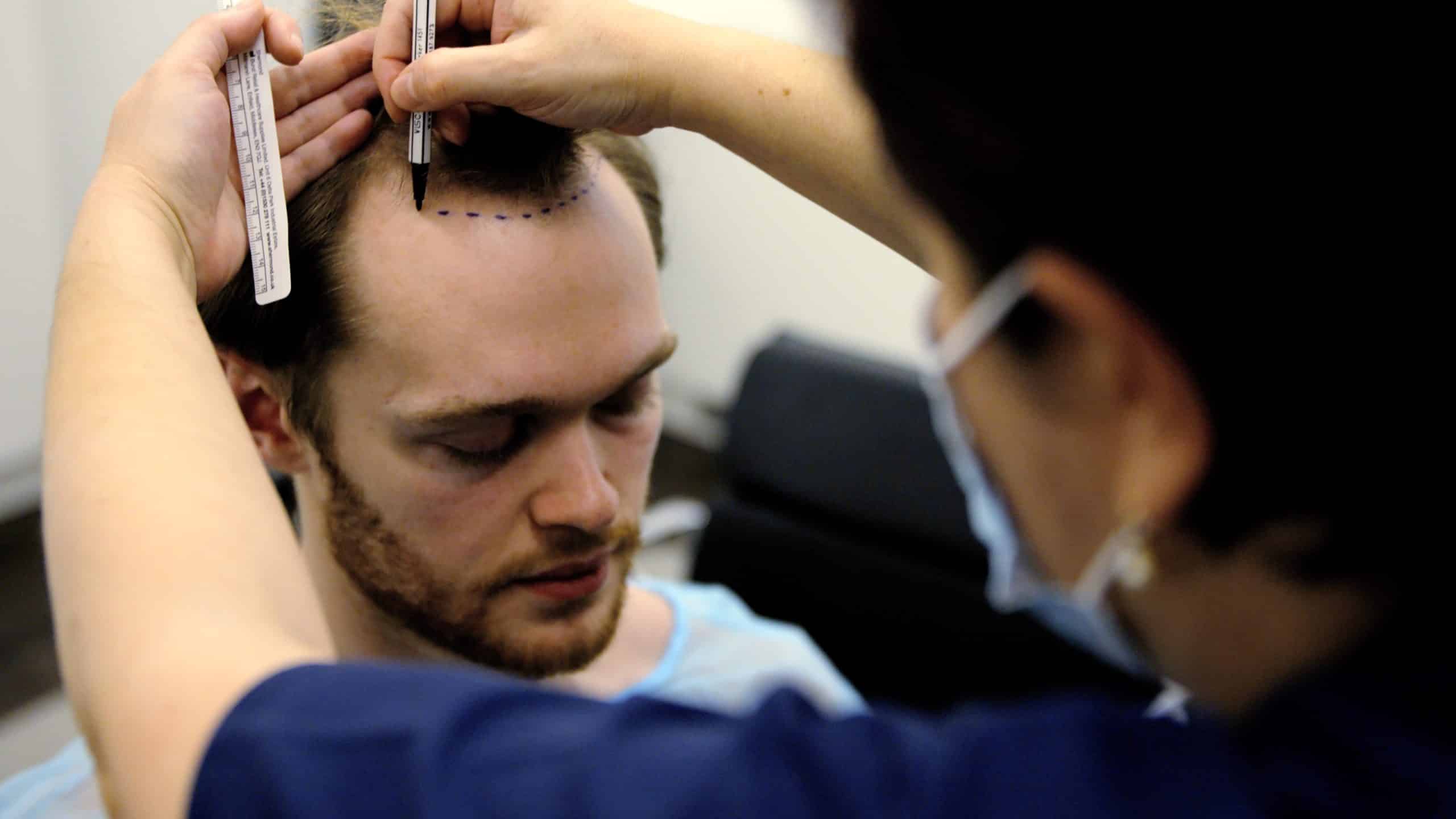
I use FUE to select very fine hair from areas around the nape, use lateral slits to create sharp exit angles to blend into the temporal point and I work around the patient’s existing forehead to create the most round and feminine hairline that can be achieved naturally. The blending with the temporal point is the key to success normally and the most difficult part of the transplant surgically.
Transgender patients usually worry the most about shaving at the donor for FUE and may select FUT for this reason. Unfortunately, FUT normally cannot provide the fine soft hair that is required for this transplant. There are numerous discrete shaving options available or even in certain cases, no shaving FUE options. Patients should normally be able to leave the clinic with no evidence of shaving with the hair down. We can normally find a way to manage a patient through this time, with the use of extensions or hair pieces, or simply a realistic time period to recover from the surgery away from the public. Patients are usually surprised how quickly the shaved areas camouflage with the longer hair areas and within weeks they are usually very difficult for someone else to discover.
Feminising The Hairline
For transfeminine patients, the goals are to round a masculine hairline and to address the androgenetic loss caused by pre-transition testosterone exposure.
Lowering a masculine hairline means filling in the receded frontotemporal corners to create a soft, rounded perimeter. Surgeons avoid bringing it down too far, since an unnaturally short forehead can unbalance the face and a low hairline can look flat rather than round. To keep it natural, single-hair grafts are placed along the front 0.5 to 1 centimetre in an irregular, micro-zigzag pattern, with multi-hair grafts set behind that feathered transition zone to build density.
Hairline feminisation often coincides with forehead contouring to reduce a prominent brow bone, since the masculine forehead tends to have heavy brow projection while the feminine forehead is smoother and more convex. Addressing bone and hairline together brings the upper third of the face into balance.
Where FUE Refines The Result
Surgical advancement can lower a central hairline, but it cannot fully round out deep temporal recessions without placing too much tension on the sides of the scalp. FUE fills that gap.
Rounding the temporal peaks. Grafts from the occipital safe donor area fill the acute temporal angles to complete the feminine oval.
Scar camouflage. Single-hair grafts placed into and in front of a pretrichial scar conceal the incision line.
Micro-feathering. Fine single-hair grafts placed at shallow exit angles of around 10 to 15 degrees mimic natural feminine growth.
The Role Of Hormone Therapy
Gender-affirming hormone therapy plays a real part in planning. Oestrogen and anti-androgens suppress DHT, which halts further androgenetic loss and can reverse recent miniaturisation, stabilising donor density and revealing the true extent of permanent loss before a design is drawn. Most protocols recommend stable hormone therapy for at least twelve months before a feminising transplant.
Speak To Our Team
Feminising hairline work is delicate, artistic, and best done by a clinic experienced in it, in a supportive setting. If you would like a careful assessment of what can be achieved for your face, you can explore ourtransgender hair transplant service to learn more and get in touch.