For most people, a hair transplant means moving hair from the back of the head to the top. What far fewer realise is that when the scalp cannot supply enough, hair from the beard and the body can step in. Using chest hair for hair transplant procedures, along with beard hair, is one of the more advanced and often misunderstood areas of hair restoration, and it is exactly the kind of complex case that belongs in experienced hands.
This guide explains how body and beard hair are used as donor sources, how they differ from the scalp hair most transplants rely on, who they suit, and what the common concerns really amount to. Because using chest hair for hair transplant procedures is a specialist undertaking, the honest detail matters more here than almost anywhere else in hair restoration.
Why Look Beyond The Scalp At All
The hair at the back and sides of the scalp is, and remains, the gold standard donor for a transplant. It is the closest match to the hair it replaces and it gives the most reliable results. According to industry data, scalp hair is used in the large majority of all transplants performed.
The problem is that this donor supply is finite. Some men do not have enough of it to cover what they have lost, particularly those with advanced baldness, and others have already spent much of it on previous procedures or had it depleted by an overharvested transplant elsewhere. When the scalp can no longer meet the need, the beard and body become a way to extend the total supply of grafts available. This is known as body hair transplantation, or BHT, and it uses the same follicular unit extraction method as a standard transplant, simply drawing from a different source.
One principle sits above all others here, and any honest clinic will lead with it. Body and beard hair is almost always supplemental, not a standalone solution. The strongest results come from combining whatever good scalp donor remains with beard and body hair, not from replacing one with the other.
How Body And Beard Hair Differ From Scalp Hair
This is the part that readers new to the subject most need to understand, because body hair does not behave exactly like scalp hair, and pretending otherwise is how patients end up disappointed. The differences are real, and they shape every decision a surgeon makes.
- Growth cycle and length. Scalp hair has a long growth phase, which is why it grows long. Body hair has a shorter growth phase, so it tends to stay shorter even after it is moved to the scalp. Beard hair sits somewhere closer to scalp hair, which is part of why it is prized.
- Texture and calibre. Body and beard hair is often thicker, coarser, or curlier than scalp hair. Beard hair in particular is wire-like, with a shaft diameter that often exceeds 100 micrometres, close to double the cross-section of typical scalp hair at 60 to 80 micrometres. Used well, that coarseness adds real visual density. Used carelessly, it stands out.
- Follicle structure. Scalp hair usually grows in natural groupings of two to four hairs. Beard hair comes as single and two-hair units, and body hair almost always as single follicles, which affects how each is used and where.
- It keeps its character. A crucial point. Transplanted body and beard hair largely retains its own curl, colour, and calibre rather than transforming into scalp hair. A skilled surgeon plans around this, mixing grafts so the result blends rather than patches.
- Exit angle. Body hair, and chest hair in particular, tends to grow out of the skin at a sharp, flat angle, which makes clean extraction more difficult and slower than on the scalp.
Harvesting from the beard and body is more demanding than scalp work. The skin is elastic, the hair angles are acute, and the follicles are more fragile, so the procedure calls for specialised, non-shaven extraction technique and, increasingly, skin-responsive tools that keep follicle damage low. This is a large part of why body hair work rewards a surgeon who does it regularly.
The Donor Hierarchy: Beard, Chest, And Beyond
Not all non-scalp hair is equally useful, and surgeons follow a clear order of preference based on how well each source survives and blends. A comparative study of scalp, beard, and chest hair survival confirms that these sources behave differently once moved, and that beard and body grafts keep their own characteristics rather than taking on those of scalp hair.
Beard hair is the strongest body donor by some margin. It is thick, it is resistant to the hormone that drives pattern baldness, and it has the highest survival rate of any non-scalp source, commonly cited in the region of 80 to 95 percent in a healthy donor. Its coarseness makes it excellent for adding density, and it is usually harvested from under the chin and jawline, where healing is discreet. Because it resists DHT, beard hair can be a sensible choice for zones like the crown where genetic loss may continue. It is worth noting the traffic runs both ways, since the beard can serve as a donor for the scalp, and scalp hair can equally be used to fill a patchy beard, as we cover in our look at beard transplants.
Chest hair is the next option when the beard alone cannot supply enough. It can add useful bulk, but it comes with trade-offs. Its survival rate is typically lower than beard hair, often cited around 60 to 76 percent, partly because of that flat exit angle which raises the risk of damaging follicles during extraction. Chest hair also varies enormously from man to man, so its usefulness is assessed case by case.
Other body areas, such as the abdomen, legs, or arms, sit lower still and are generally treated as a last resort, with less predictable results.
Placing The Grafts: The Mix And Blend Approach
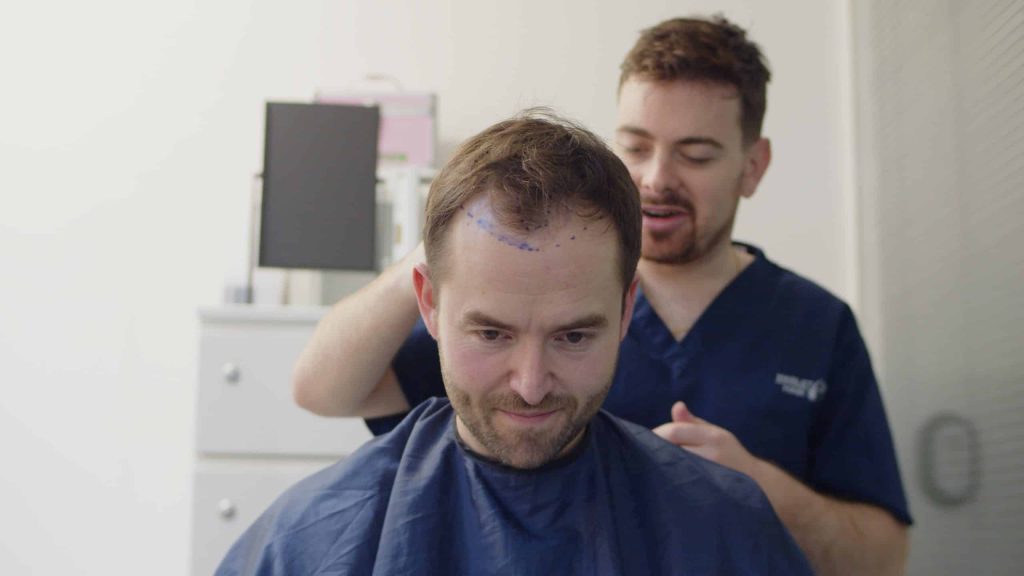
Because non-scalp hair keeps its own character, dropping a solid block of beard hair into a visible part of the scalp would look patchy and artificial. The skill lies in distributing the different grafts by zone, playing each type to its strength.
- The hairline and temples. Beard hair is never placed in the first one or two rows of the frontal hairline, where its heavy calibre would look plug-like. Those borders are reserved for fine single-hair scalp grafts, or the finest body grafts, to keep the edge soft.
- The mid-scalp. Here beard grafts are interspersed with scalp grafts, often at a ratio of somewhere between one to one and one to three, so the thick beard hair builds density and shadow while the scalp hair disguises any textural difference.
- The crown. The vertex swallows grafts, so coarse beard hair is layered in the deeper areas for volume, with finer chest hair used nearer the whorl, preserving precious scalp grafts for the front.
This zone-based blending is the difference between a result that reads as one natural head of hair and one that betrays its mixed sources.
Who Is A Candidate For Body And Beard Hair?
Body and beard hair is not a first-line treatment, and a responsible clinic will say so plainly. It becomes relevant in specific situations.
- Men with advanced hair loss, broadly in the higher Norwood stages, whose scalp donor cannot cover the area alone.
- Patients who have had previous transplants and need additional grafts to build further density.
- Repair cases, including those left with a depleted or overharvested scalp donor, where extra grafts must be found somewhere.
- Those needing to camouflage or fill an old FUT strip scar, where body hair can help.
Just as important is who it does not suit. A patient hoping to rebuild a soft, natural frontal hairline from chest hair alone is not a good candidate, because the texture is wrong for that most visible of zones. And not everyone has usable body hair at all. Some men’s beard or body hair is too fine or too sparse to yield a worthwhile result, some have hair so different from their scalp that it cannot be blended convincingly, and in some cases the hair cannot be extracted cleanly for anatomical reasons. Honest candidacy assessment is what separates a sensible plan from an oversold one, and it is a conversation, not a sales pitch.
What Happens To The Donor Area Afterwards
A question we are asked constantly, and a fair one, is what the beard or chest looks like after grafts are taken. The reassuring answer is that, done properly, the donor areas heal well and discreetly.
Beard hair is harvested from under the chin and along the jawline, areas that are naturally shaded and easy to conceal while they heal, and because the extractions are spread out, the beard density above is not visibly reduced for most men. The chest, similarly, is harvested conservatively across a wide area so that no single patch is thinned, and the tiny extraction points heal as small marks that are typically well hidden by the remaining chest hair. As with scalp FUE, the same rule of conservative, even harvesting applies, taking too much from a body donor causes the same patchy problems it would on the scalp. In practice, the beard and chest recover their appearance while contributing grafts the scalp could never have spared.
Dr Ness’ Experience
Many patients are concerned by the use of beard or body hair. Patients worry about how the different hair will blend with their existing scalp hair. There is an artistic skill in being able to blend the different quality hairs together as one unit. I often use the analogy of a lawn with different types of plants and grasses, if there is one type of grass, this is better, but having something covering the soil is usually better than nothing. Beard and body hair will respond to ongoing male pattern baldness differently too from scalp hair. Beard hair varies greatly just like scalp hair does, so having a bespoke plan that has been created from seeing your specific scalp and beard hair is vital. In many patients, particularly those who have exhausted their donor supply or are covering a huge area, the use of beard hair and even body hair can greatly improve the result.
The technique can be more difficult and patients can worry that it could be more painful, however in my experience this has not been the case. It is less painful and heals faster.
The Bottom Line
Body and beard hair has widened what is possible in hair restoration, offering a real path forward for men who were once told their donor supply had run out. It is not a magic fix, and it is not a substitute for scalp hair. It is a specialist tool that, in the right hands and combined with careful planning, can extend density and rescue cases that would otherwise be stuck.
The recurring lesson is that this is expert territory. The difference between a body hair transplant that blends seamlessly and one that looks patchy comes down to assessment, planning, and surgical skill. If you have been told your scalp donor is insufficient, or you are exploring options after a previous procedure, our surgeons can give you a straight assessment of what your beard and body hair could realistically add. You can talk it through with our team when you are ready.
Frequently Asked Questions
Can you use chest hair for a hair transplant?
Yes. Chest hair can be used as a supplementary donor source when scalp and beard hair cannot supply enough grafts. It adds bulk and density behind the most visible areas, though its survival rate is lower than beard or scalp hair and it is assessed on a case-by-case basis.
Is beard or chest hair better for a transplant?
Beard hair is generally the stronger of the two. It has a higher survival rate, is thicker, and resists the hormone behind pattern baldness, so it is used first. Chest hair is the next option when the beard alone is not enough.
Does transplanted body hair look like scalp hair?
Not exactly. Body and beard hair keeps much of its own texture, curl, and length characteristics after transplant. A skilled surgeon mixes the grafts and places them where their texture blends, which is what makes the result look natural.
Can body hair be used for the hairline?
Generally no. The texture of body and chest hair is not suited to the soft, fine frontal hairline, where scalp hair is strongly preferred. Body hair is best used for density behind the hairline.
Who is a good candidate for a body hair transplant?
It suits men with advanced hair loss and limited scalp donor, those needing extra grafts after a previous transplant, and repair cases including depleted or overharvested donors. It is supplemental to scalp hair, not a standalone solution.
Does taking beard or chest hair ruin the donor area?
No, when done conservatively. Grafts are spread across a wide area so no patch is visibly thinned, and the extraction points heal discreetly, particularly under the chin and jaw for beard hair. Overharvesting a body donor causes the same problems it would on the scalp, which is why careful planning matters.
How long do body hair transplant results take?
Longer than a standard scalp transplant. Full results often take around twelve to eighteen months or more, because body hair grows and settles more slowly.
Is a body hair transplant permanent?
Yes. Once the transplanted follicles establish, they are a permanent addition and follow their own natural growth cycle, while keeping their original characteristics.
Is a body hair transplant painful?
No more than a standard FUE. It is done under local anaesthetic with only minor discomfort, and FUE is well tolerated overall, with any side effects such as temporary folliculitis usually short-lived.
Related Posts
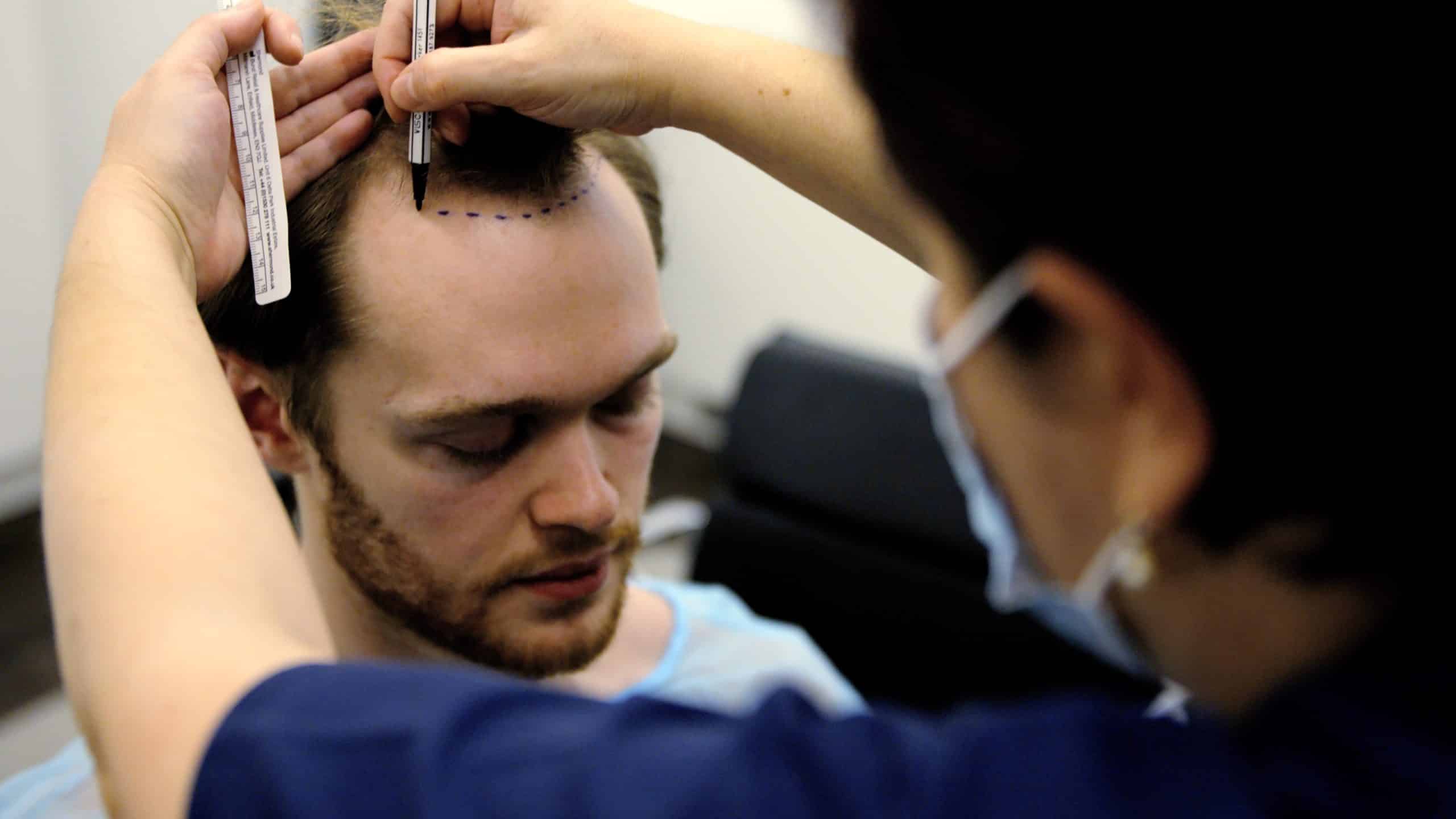
The Art of Hairline Design in FUE Hair Transplants
Learn why hairline design in FUE hair transplants decides a natural result, from face shape and soft temples to planning for future hair loss.
Overharvested Donor Area: Causes, Risks & How to Prevent It
Learn what causes an overharvested donor area after a hair transplant, the lasting risks, and how to choose a surgeon who protects your donor.