
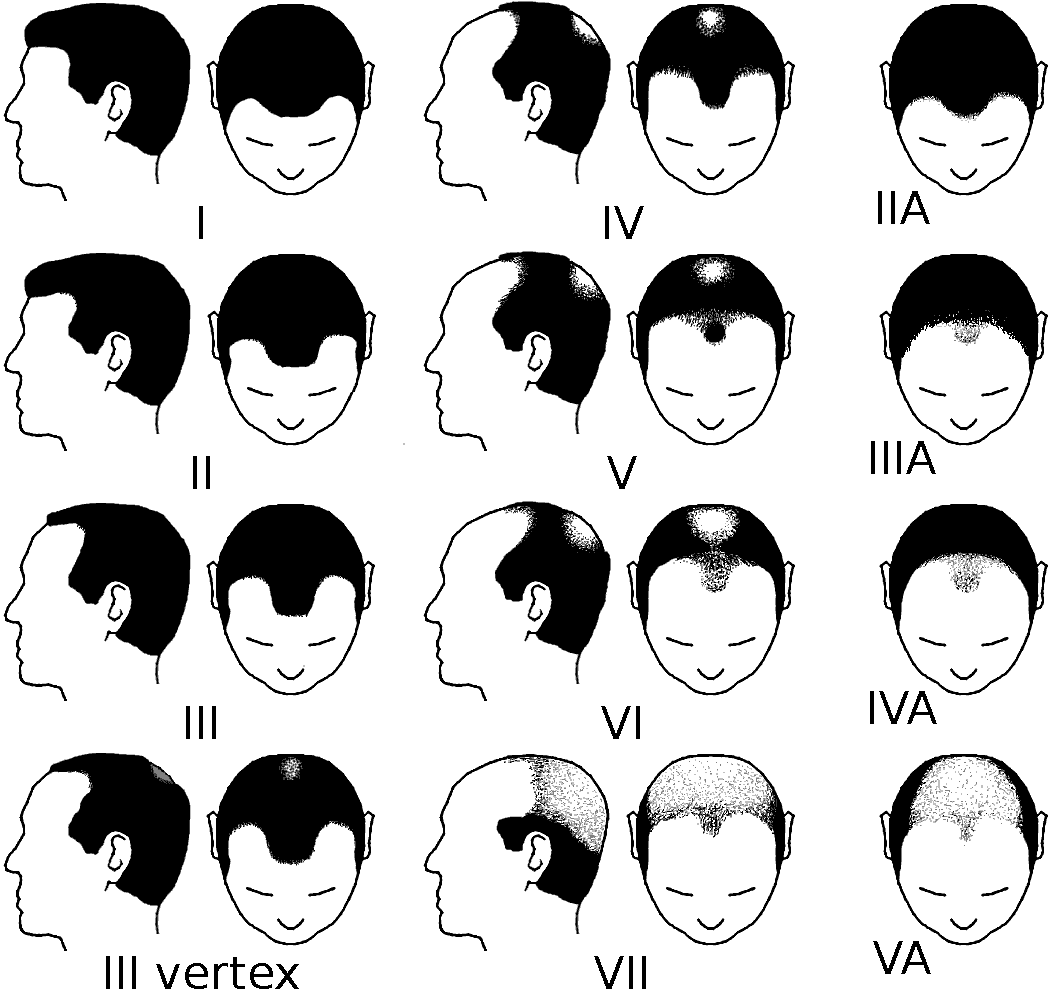
If you have looked into hair loss at all, you have almost certainly met the Norwood scale, even if you did not know its name. It is the row of seven heads, each balder than the last, that appears in nearly every article and every consultation on male hair loss. It exists for one simple reason. It gives a man and his doctor a shared language for something that is otherwise hard to describe, turning a vague worry about thinning into a specific, agreed reference point.
This guide will help you finally understand where you stand. It explains what the scale is, walks you through each stage in plain terms so you can place yourself on it, and shows you what your stage means for your options and how to move forward from here.
What The Norwood Scale Is
The Norwood scale, more formally the Hamilton-Norwood scale, is the standard system for classifying male pattern baldness, known medically as androgenetic alopecia. It sorts hair loss into seven stages, from a full head of hair at stage 1 to the most advanced loss at stage 7, where only a horseshoe band remains around the sides and back of the head. According to the International Society of Hair Restoration Surgery, the scale runs from Norwood 1, no hair loss, to Norwood 7, the most advanced.
This scale is one of the most valuable tools in consultations, where it helps a surgeon judge how much hair has been lost and, just as importantly, how much donor hair is available to restore it.
Most people arrive at the scale after noticing their own hairline creeping back and wondering how they got here. If that is you, our guide on what causes a receding hairline explains the reasons behind it.
The Seven Stages, One By One
Here is what each stage looks like in practice. Bear in mind that real hair loss does not always fall neatly into a single class, and many men sit between two stages or show features of the Type A.
Stage 1
A full head of hair with no meaningful loss. The hairline may have matured slightly from its adolescent position, which is normal and not a sign of balding. Many men stay here for life.

Stage 2
The first minor recession appears at the temples, giving the hairline a slightly triangular shape, the beginning of a widow’s peak. This is still not classed as balding, and it is the ideal window for early intervention, when treatment has the most hair to protect.
Stage 3
This is the first stage the scale considers balding. The recession at the temples deepens, and the hairline takes on a recognisable M, U, or V shape. A separate variant, Stage 3 vertex, describes early thinning at the crown while the hairline is still only mildly affected.
Stage 4
Hair loss becomes more pronounced. The temple recession is more advanced, and there is now noticeable thinning or a bald patch at the crown. A bridge of hair still separates the two areas, keeping the front and the crown as distinct zones of loss.
Stage 5
The areas of loss are larger, and the bridge of hair dividing the frontal region from the crown grows narrower and thinner. The two zones are still separate, but the connection between them is starting to break down.
Stage 6
The bridge disappears. The balding at the front and the crown merge into one continuous area across the top of the scalp, with hair remaining mainly at the sides.

Stage 7
The most advanced stage. Only a narrow horseshoe band of hair remains, wrapping around the sides and back of the head. The entire top of the scalp is bald. Even here, that remaining band is DHT-resistant hair, which is why transplantation can still be possible depending on how much donor supply is left.
The Type A Variant
Not everyone loses hair in the standard front-then-crown sequence. The Type A variant describes a less common progression where the entire hairline recedes from front to back in one advancing line, without forming a separate bald spot at the crown. It tends to produce a more uniform retreat rather than the two distinct zones of the classic pattern. It is worth knowing about, because a man following the Type A pattern can look at the standard diagram and feel it does not quite match what he sees, which is precisely why a proper assessment beats self-diagnosis.
What Each Stage Means For Treatment
Your stage is a useful guide to which options tend to fit, though the right choice always depends on your rate of loss and, for surgery, your donor supply. As a broad map rather than a rule, treatment tends to group like this.
| Stage | What usually fits |
| Stages 1 to 2 | Not yet balding. Medical treatment to protect existing hair, or a small procedure of around 500 to 1,000 grafts to refine an early hairline |
| Stages 3 to 4 | The common transplant range, typically 1,000 to 2,500 grafts depending on the area, alongside medication to hold surrounding hair |
| Stages 5 to 6 | Larger procedures are possible, with the plan shaped by how much donor hair is available |
| Stage 7 | A transplant can still help, but the goal shifts to making the best use of limited donor supply, often prioritising the frontal area |
The earlier you address pattern loss, the more hair there is to protect and the more options stay open.
For a fuller look at the non-surgical side, our guide to the best hair loss treatments for men breaks down what works.
Why Male Pattern Baldness Follows A Pattern
For anyone curious about the biology behind the stages, the loss follows a map for a specific reason. Male pattern baldness is driven by a hormone called dihydrotestosterone, or DHT, which the body converts from testosterone using an enzyme called 5-alpha-reductase. In men who are genetically susceptible, the hair follicles in certain areas of the scalp are sensitive to DHT. When DHT binds to these follicles, it triggers a process called miniaturisation, shortening the growth phase of the hair cycle so that follicles produce progressively thinner, shorter hairs until, eventually, they stop producing visible hair at all.
This is why the loss is patterned. The follicles at the front, temples, and crown carry more DHT sensitivity, while the hair around the back and sides is far more resistant, protected at a cellular level. That resistant band is what survives even in advanced baldness, and it is the same hair used as donor supply in a transplant, because it keeps its resistance even when moved. Androgenetic alopecia is also strongly hereditary and affects around half of all men to some degree over their lifetimes, which is why it is so common and so predictable.
A Little History
The double name reflects two doctors, decades apart. The dermatologist James Hamilton first mapped the pattern of male hair loss in the early 1950s after studying hundreds of men. Two decades later, in 1975, the surgeon O’Tar Norwood refined and expanded it after studying a thousand more, adding the vertex pattern and the Type A variant. His version is the one still used in clinics worldwide today, which is why the scale carries both their names.
What The Scale Is Good For, And Where It Falls Short
This is the part most guides skip, and it is the most important. A Norwood stage is a snapshot of where your hair is today. It is not a forecast. It tells you nothing about how quickly you reached that point or how fast, if at all, you will move to the next stage. Two men at the same stage can have completely different futures, one stable for a decade, the other progressing within a year.
What the stage is good for is giving you and a clinician a shared starting point and a rough guide to sensible options. What it cannot do is predict your progression or replace a proper look at your scalp.
A crucial caution. The scale describes male pattern baldness specifically. If your hair loss looks different, falling out in patches, coming on suddenly, or arriving with scaling, redness, or pain, that may point to a different condition entirely, and it is a reason to see a doctor rather than reach for the Norwood chart. Self-staging from a diagram is a useful starting point for a conversation, not a diagnosis.
How To Track Your Own Hair Loss
Because the scale is a snapshot, the useful thing is watching the trend over time rather than fixating on a single reading. A simple habit works well. Every couple of months, take clear photos of your hairline and crown from the front, top, and back in consistent lighting, and compare them over time. A slow or stable picture is reassuring. A clear progression across a few months is the signal to seek advice while you still have the most options open.
Early recession at the temples is one of the most common first signs men notice. If you are wondering how styling plays into it, our guide to the worst haircuts for a receding hairline covers the cuts that draw the eye to thinning and the ones that work with it.
When To Seek Professional Advice
The scale is a tool for understanding, not a substitute for assessment. A specialist can confirm your stage, check that your loss is truly pattern baldness rather than something else, judge your donor supply, and give you a straight view of which options fit. That combination is something no chart can give you.
If you want to know your stage and what it means for you, our team can assess your hair loss properly and talk you through the realistic options. It is the difference between guessing from a diagram and knowing where you truly stand.
Frequently Asked Questions
What is the Norwood scale?
It is the standard medical system for classifying male pattern baldness, running through seven stages from a full head of hair at stage 1 to a horseshoe band of remaining hair at stage 7. It gives doctors and patients a shared reference for the extent of hair loss.
What are the stages of the Norwood scale?
Stage 1 is no loss. Stage 2 is minor temple recession. Stage 3 is the first balding stage with an M-shaped hairline. Stage 4 adds crown loss with a bridge of hair between. Stage 5 sees that bridge thin. Stage 6 is where front and crown merge. Stage 7 leaves only a horseshoe band at the sides and back.
What Norwood stage am I?
You can get a rough idea by comparing your hairline and crown to the stages above, but self-staging is only a starting point. A specialist assessment gives you an accurate stage and, more usefully, a read on how your loss is progressing.
Does the Norwood scale predict future hair loss?
No. A stage is a snapshot of your hair today, not a forecast. It does not indicate how fast you will progress, if at all. Tracking changes over time is more telling than any single stage number.
What causes male pattern baldness?
It is caused by the hormone DHT acting on genetically sensitive hair follicles, gradually shrinking them through a process called miniaturisation. It is largely hereditary and affects around half of all men over their lifetimes.
At what Norwood stage should I consider treatment?
Earlier stages are generally the best time for medical treatment that protects the hair you still have, while later stages are where a transplant becomes a stronger option. The right answer depends on your rate of loss and donor supply, which is a matter for professional assessment.
Is the Norwood scale used for women?
No. Female pattern hair loss follows a different pattern and is classified using the Ludwig scale instead.
Can you have a hair transplant at any Norwood stage?
Candidacy depends less on the stage itself and more on your donor supply and the pattern of loss. Even at advanced stages a transplant can be possible, though the goal shifts towards making the best use of the donor hair available.
Related Posts

Does Minoxidil Work? Results & Evidence
Thinning at the crown and wondering does minoxidil work? See the clinical evidence, realistic timelines, and the factors that shape your results.

Finasteride Side Effects: Risks, Rates and Reversibility
Worried after reading online? Here is the evidence on finasteride side effects: how common each one is, how serious, and when to speak to a doctor.