
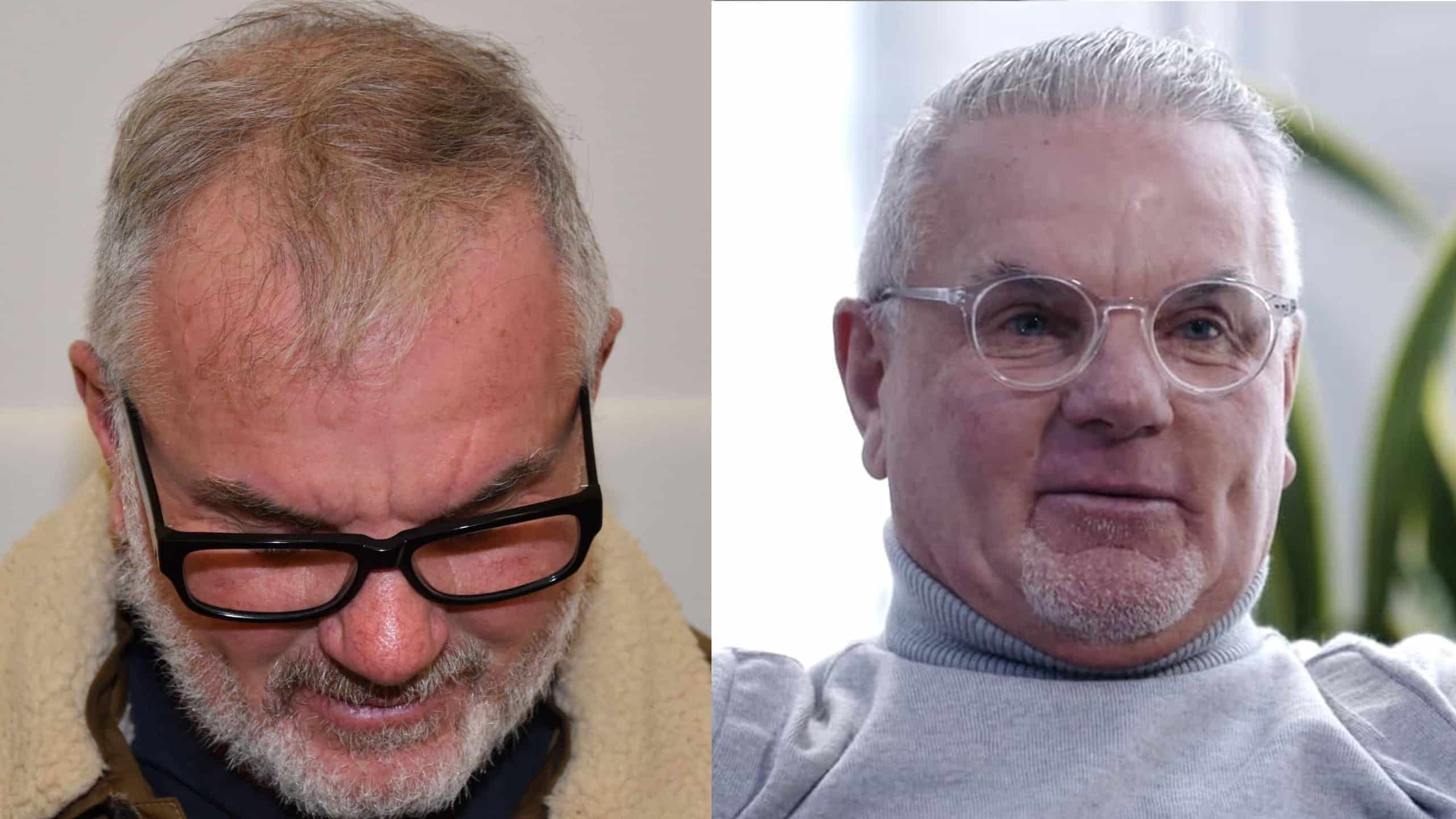
Of all the common session sizes, this is the one where planning stops being optional. Up to around 2,000 grafts, most procedures point at a single obvious target. At 2,500, you have enough hair to make real choices about where it goes, one large area or two smaller ones, the front or the crown, density now or coverage held in reserve. That freedom is the whole appeal, and it is also the reason a 2,500 graft procedure lives or dies on the plan behind it.
This article is here to answer the questions that come up most at this size. What 2,500 grafts can cover and how they can be arranged, what the price does and does not include, and what the first year actually looks like once the work is done.
The Options 2,500 Grafts Give You
A 2,500 graft session places roughly 5,000 to 6,500 hairs, since each follicular unit carries an average of two to three. That is a substantial amount of hair, enough to treat a large single region at full density or to spread across two connected areas. The right arrangement depends entirely on your pattern of loss, and this is where the planning matters most.
Broadly, 2,500 grafts can be used in one of the following ways.
- One large zone at full density. Committed to a single area, 2,500 grafts can rebuild a full frontal hairline and carry it back through the mid-scalp as one connected region, giving strong, natural density across the front of the head.
- Hairline plus partial crown. Split between two zones, a common allocation puts the larger share into the hairline and mid-scalp and the remainder into a thinning crown, treating both in one session where each area is moderate.
- A whole crown. Directed at the vertex alone, 2,500 grafts can cover a sizeable balding crown. The crown’s spiral growth pattern reads as full at a lower density, so grafts stretch further there than at the hairline. Our crown hair transplant timeline walks through how a crown case heals and grows if that is your main concern.
- Beyond the scalp. The same volume works for larger restorations elsewhere, such as a full beard, though scalp restoration is the usual use at this count.
The one thing 2,500 grafts cannot do is cover an entire advanced, fully balding scalp at once. Where loss is that extensive, the honest plan is a higher count or a staged approach across sessions.
Can You Split The Grafts However You Like?
Within reason, yes, but not without trade-offs. Splitting 2,500 grafts across two zones means neither gets the full count, so both areas need to be modest for a split to look dense in each. Push the division too far, spreading grafts thinly across three areas, and you lose the density that makes any of them convincing. A surgeon plans the division around the size of each zone and the density each needs, which is why the arrangement is a clinical decision rather than a simple preference. This is also the stage where protecting your donor supply for the future starts to shape the plan, since 2,500 grafts is a meaningful draw on a finite reserve.
Is 2,500 Grafts Right For You
On the Norwood scale, 2,500 grafts commonly suits men at stage 3 to 4, where loss has moved beyond the hairline into the mid-scalp or opened a defined bald spot at the crown. For women, it typically maps to Ludwig stage 3, more advanced diffuse thinning across the top of the scalp. The shared thread is loss that is moderate to moderately advanced but still contained enough that a single session, well planned, can make a genuine difference.
What Your Price Covers
A 2,500 graft procedure sits among the larger single sessions, and UK pricing reflects that. At reputable clinics the figure generally runs from around £6,000 to £10,000, with London and surgeon-led clinics towards the upper end. The exact number depends on your case, which is why so much of the figure comes down to what a quoted price actually covers. Before comparing two clinics, it helps to know what each one includes:
- The consultation and scalp assessment.
- The surgery itself, including the surgeon’s time and the surgical team.
- Local anaesthetic and any medication given on the day.
- Post-operative aftercare instructions and follow-up appointments to review your progress.
What a price often does not include, and worth checking for:
- Travel to the clinic and any accommodation, particularly relevant if you are travelling for surgery.
- Supportive treatments such as medication or PRP, if recommended alongside the transplant.
- Any future top-up procedure, should your natural hair continue to thin over the years.
Why The Price Range Is So Wide
If two clinics quote very different figures for the same graft count, the gap usually reflects real differences rather than arbitrary pricing. The main factors are:
- Who performs the surgery. A procedure carried out by a GMC-registered surgeon costs more than a technician-led one, and it is the single biggest influence on both price and result.
- Where the clinic is. A regulated London clinic carries different overheads and standards than a high-volume operation abroad.
- The complexity of your case. Splitting grafts across zones, working around scar tissue, or a difficult hair type all add to the time and skill involved.
- Hair characteristics. Coarse or curly hair covers more area per graft, which can affect how many grafts a plan needs and what it costs.
Because the right figure depends so heavily on your own pattern and plan, a quote after assessment is the only dependable number. You can contact us to talk through your case and get one.

Results: What The First Year Looks Like
The single most useful thing to understand about results is that the first year is a process, not an event. The goal across those twelve months is steady, and the timeline is predictable enough to know when to be patient and when to expect change.
Early on, within the first few weeks, the transplanted hairs shed. This is shock loss, and it is normal, the follicles resting before they begin to grow. It is not a sign the procedure has failed, though it catches people off guard if they are not expecting it. The donor and recipient areas heal in this same early window, and our guide to FUE hair transplant scars explains how the small extraction marks fade.
From around three to four months, new growth starts to appear, fine at first. Through the middle of the year it thickens and gains texture, and by about six months roughly half the final result is visible. The back half of the year is where density fills in properly, and the full, mature result arrives at around twelve months. For a larger session like 2,500 grafts, that final picture can be a substantial change.
| Timeframe | The goal at this stage |
| First 2 weeks | Grafts settle and secure, initial healing |
| Weeks 2 to 8 | Shock loss runs its course, no visible growth yet |
| Months 3 to 4 | First new hairs appear |
| Months 6 to 9 | Around half to two-thirds of the result shows, thickening |
| Around 12 months | Full density and the final result |
The transplanted hair is permanent, drawn from the loss-resistant donor zone. The native hair around it can still thin over time, which is why the main goal in that first year is not only new growth but protecting what you already have alongside it.
A Quick Comparison Across Graft Counts
To place 2,500 in context, here is how the common session sizes compare at a glance. These are broad guides, not a substitute for an assessment.
| Grafts | Typically suits | What it broadly covers |
| 500 | Norwood 2 | Hairline refinement, one small area |
| 1,000 | Norwood 2 to 3 | A rebuilt hairline or both temples |
| 1,500 | Norwood 3 | Two modest zones, or a moderate crown |
| 2,000 | Norwood 3 to 4 | Full front third at natural density |
| 2,500 | Norwood 3 to 4, Ludwig 3 | One large region, or a well-judged two-zone split |
The pattern across the range is consistent. More grafts do not simply mean more hair, they mean more of the scalp can be treated, or the same area treated more densely. Which is right for you is a question of area and donor supply, settled by measuring your scalp rather than reading a table.
Bringing It Together
A 2,500 graft procedure is defined by its flexibility. It is enough hair to restore a large single area or to treat two at once, which makes the plan behind it the thing that decides the result. Matched well to your pattern, it delivers a substantial, natural change while keeping a careful eye on the donor supply you may need again.
The plan that fits your head is something only an assessment can draw up. If you want to understand your options or find out how 2,500 grafts would be arranged for your pattern, booking a consultation is the right next step. Our GMC-registered surgeons will map your scalp and give you a straight answer.
Frequently Asked Questions
How many hairs is 2,500 grafts?
Around 5,000 to 6,500. Each graft is a follicular unit of one to four hairs, most often two to three, so your exact total depends on your natural grouping.
What can 2,500 grafts cover?
Either one large area at full density, such as the whole front of the scalp, or two smaller zones together, such as the hairline and a partial crown. It cannot cover an entire advanced, fully balding scalp in one session.
Can I split 2,500 grafts between my hairline and crown?
Yes, provided both areas are moderate. The count is divided so each zone gets enough grafts to look dense. A surgeon plans the split around the size and density needs of each area.
How much does a 2,500 graft hair transplant cost in the UK?
It sits at the higher end of session pricing, and the figure depends on the surgeon, the clinic, and the complexity of your case. A quote after assessment is the dependable number.
Is 2,500 grafts a large procedure?
Yes, it is one of the larger single-session sizes, a full-day procedure. It is substantial but still draws on only part of a healthy donor supply.
When will I see the final result?
New growth begins at three to four months, about half shows by six months, and the full result arrives at around twelve months.
Does a 2,500 graft transplant use up my donor hair?
It is a meaningful draw on the donor area but does not exhaust a healthy supply. Conservative extraction in this session helps keep options open for any future work.
Is 2,500 grafts enough to cover a bald crown?
A sizeable crown, yes, treated on its own. Because crown hair reads as full at a lower density, grafts cover more area there than at the hairline.
Does the procedure leave a scar?
Not with FUE. Extraction uses tiny individual punches that heal as small, barely visible marks, with no linear scar.
Is a 2,500 graft hair transplant available on the NHS?
No. The NHS treats hair transplants for pattern baldness as cosmetic surgery and does not fund them, so treatment is private.
Related Posts
Hair Transplant After 1 Month: Shock Loss Explained
Shedding at its peak? Here is why hair transplant after 1 month looks thinner than before, what shock loss means, and when new growth truly begins.
Hair Transplant After 2 Weeks: Healing, Shedding & Care
Scabs gone, grafts secure, shedding starting. Here’s what a hair transplant after 2 weeks looks like, plus what you can and cannot do just yet.