If you have started researching a hair transplant, you have almost certainly run into a wall of acronyms, and the three that matter most are FUE, FUT, and DHI. They are the main techniques used today, they produce very different experiences, scars, and price tags, and the marketing around them is not always straight about the differences. The truth is that no single one is best for everyone, and the right method depends on your hair loss, your donor supply, your budget, and how you want to wear your hair afterwards.
This guide breaks down the fue vs fut vs dhi question the way we would explain it to a patient, taking each technique in turn so you can see clearly how they extract and place hair, how they scar, how they recover, and what they cost. Each method has situations it suits and situations it does not, and understanding those is what turns a confusing set of acronyms into a decision you can confidently make. By the end, and with the help of a clear overview table, choice should feel a good deal simpler.
FUE: Follicular Unit Extraction
Over the years, our team has perfected the FUE hair transplant method, so it is one we can talk about with real confidence. FUE is the modern standard in hair restoration, and it works by harvesting individual follicular units one by one, directly from the donor area at the back and sides of the scalp, using a tiny cylindrical punch. Each unit is then placed into the recipient area. Because no strip of skin is removed and no stitching is involved, FUE avoids the single biggest drawback of the older strip method, and that difference shapes almost everything about the experience, from the scarring to the recovery to how you can wear your hair afterwards.
The Benefits Of FUE
The benefits are clear, and they are why the field has moved decisively in this direction. FUE leaves no linear scar, only tiny dot-like marks that fade to near invisibility as the surrounding hair grows over them, which means you can crop your hair short without any tell-tale sign of surgery. Recovery is quick, with most people back to normal activities within a few days rather than weeks, because there is no closed wound to heal. Graft survival is excellent in skilled hands, typically above 90 percent, and the results look completely natural when the hairline is properly designed. It is also a versatile technique, capable of handling everything from a small hairline refinement to fairly extensive coverage, and because the donor is harvested across a wide area rather than a single strip, it can often be revisited for further work in the future. For all these reasons it is now, by a wide margin, the most common hair transplant technique performed worldwide.
Who FUE Is Best Suited For
FUE suits the large majority of people considering a transplant, which is a big part of why it has become the default. It is the natural choice for anyone who likes to wear their hair short, since there is no scar to hide, and for those who want to be back at work and normal life quickly. It works well across a broad range of hair loss, from early thinning and hairline recession through to reasonably advanced loss, provided the donor area at the back and sides is healthy enough to supply the grafts. The one honest caveat worth stating plainly is that FUE is only as good as the person performing it. The results depend heavily on the skill and care taken during extraction and placement, which is why we place so much weight on our surgeon-led FUE procedure rather than delegating the delicate work to technicians.
The Cost Of FUE
FUE typically sits in the middle of the three techniques on price. It is usually costed by the number of grafts you need rather than by the technique label, so the total reflects the extent of your hair loss and the coverage you are after. A modest hairline job sits at the lower end, while extensive restoration across the crown and front costs more simply because it involves more grafts. To get a concrete sense of how graft numbers translate into price and coverage, our breakdown of a 2,000 graft hair transplant is a useful reference point, since it sits in the range many patients fall into. In our view FUE offers the strongest value of the three, because you are paying for reliable, scar-free, natural results without the premium the newest method commands.

FUT: Follicular Unit Transplantation
FUT, sometimes called the strip method, is the original technique that FUE evolved from, and it is still performed today, though far less often than it once was. In an FUT procedure, the surgeon removes a thin strip of hair-bearing skin from the back of the scalp and closes the area with stitches. A team then dissects that strip under magnification into individual follicular units, which are implanted into the recipient area much as they would be in FUE. The extraction is the part that differs, and it is where both the strengths and the drawbacks of FUT come from.
The Benefits Of FUT
The advantages of FUT are real, which is why it retains a role. Because an entire strip of donor tissue is taken in one pass, FUT can yield a large number of grafts from a relatively small area, and dissecting under the microscope tends to preserve the follicles well, keeping transection to a minimum. That makes it efficient for large single sessions. It is also the most affordable of the three techniques, since it needs less equipment and less time at the extraction stage. For a patient with very advanced hair loss who needs a high graft count, or whose scalp laxity lends itself to strip removal, FUT can still be a sound clinical choice.
Who FUT Is Best Suited For
FUT is best suited to a specific kind of patient rather than the general case. It tends to make most sense for someone with advanced hair loss who needs a very high number of grafts in a single session, who keeps their hair long enough to keep the donor area covered at all times, and who is prioritising the lowest possible cost. For that person, the strip method can be a sound and legitimate choice, and an honest surgeon will say so rather than steer them elsewhere.
The trade-offs are what keep FUT from being a first choice for most people, and they are worth being clear about. The defining one is the scar. Removing a strip leaves a permanent linear scar across the back of the head, and while a skilled closure keeps it fine, it can never be reduced to nothing, which means you cannot shave that area to the skin without it becoming visible. In fact, a number of patients come to us having had FUT elsewhere and wishing they had not, unhappy with a scar they can no longer hide, which is why we offer scar repair to help soften and camouflage it.
Recovery is also longer than FUE, with stitches to manage and more discomfort in the first days as the wound heals. For those reasons we do not offer FUT, since for most patients the scar-free FUE achieves comparable coverage without that lasting compromise. It comes down to matching the method to the person, and for the majority, that person is a better fit for FUE.
The Cost Of FUT
FUT is generally the cheapest of the three, and for some patients that is a meaningful part of its appeal. The lower price reflects the simpler, faster harvesting stage compared with extracting thousands of individual follicles. That saving, though, has to be weighed carefully against what comes with it, the permanent linear scar and the longer, slightly more uncomfortable recovery. For many people, once they understand that the scar is lifelong and the recovery slower, the modest cost saving over FUE stops looking worth it. It is a judgement each patient has to make with a clear picture of both sides.

DHI: Direct Hair Implantation
DHI is best understood not as a rival to FUE but as a variation of it, differing only in how the grafts are placed. The extraction step is identical, with individual follicles removed exactly as in FUE. What changes is the implantation. Rather than creating all the recipient incisions first and then placing the grafts into them, DHI uses a specialised pen-like tool called a Choi implanter, which makes the incision and inserts the follicle in a single motion. The device was developed in the early 1990s at Kyungpook National University in South Korea, originally to handle the thick, straight hair common in Asian patients with greater accuracy, and it has since spread worldwide. We explore the two side by side in our look at how DHI and FUE compare.
The Benefits Of DHI
The advantages of DHI flow directly from that implanter pen. Because each graft is placed the moment its channel is made, the follicles spend less time outside the body and are handled less, which can support strong survival rates and gives the surgeon a high degree of control over the angle, depth, and direction of every hair. That precision is where DHI is at its best, making it well suited to detailed work such as refining a delicate hairline or densely packing a small, defined area. It also lends itself to no-shave procedures in certain cases, since the recipient area does not always need to be shaved down, which appeals to people who cannot take obvious downtime. A peer-reviewed account of the technique notes that implanting directly with the pen can allow denser grafting with less trauma and a bloodless field, though it also comes with a steeper learning curve for the surgical team. Some clinics report marginally higher survival figures with DHI, though the evidence that it beats a well-executed FUE on the final result is not conclusive.
Who DHI Is Best Suited For
DHI is a capable and precise technique in experienced hands, and it earns its keep in specific circumstances rather than as a general-purpose method. Its practical limitations are what define its scope. The implanter pens are expensive and the technique is slower, which pushes the cost up and makes it less efficient at covering large areas of the scalp in a single session. That combination means DHI is best reserved for smaller, precision-focused work, someone whose priority is a meticulously refined hairline, added density in a compact zone, or the ability to avoid shaving, and who is comfortable paying more for those specific benefits. For the many patients who need broad coverage across the crown and front, a skilled FUE reaches an equally natural result more efficiently and at a lower price, which is why DHI tends to be a considered choice for particular cases rather than the default.
The Cost Of DHI
DHI is the most expensive of the three techniques, and usually by a clear margin over standard FUE. The premium comes from the specialised implanter pens, the additional training the method demands, and the longer time each procedure takes. Justifying that extra cost depends entirely on what you need. For the narrow, precision-driven cases DHI does best, some patients feel the refinement is worth paying for. The honest point we make sure our patients understand is that the higher price does not, on its own, buy a better outcome, since for most goals a well-performed FUE produces results every bit as natural for less.

Key Takeaways
Stepping back, here is the essence of each technique in a sentence or two.
FUE is the modern all-rounder and our method of choice. It gives scar-free, natural results with a quick recovery, suits almost everyone, and sits in the middle on price. For most people asking this question, it is the answer.
FUT is the older, cheaper, strip-based method. It can deliver a high graft count in one session and costs the least, but it leaves a permanent linear scar and has a longer recovery, so it makes sense mainly for specific high-graft cases where cost matters and the hair is worn long.
DHI is a precise, premium variation of FUE using an implanter pen. It excels at detailed hairline and small dense areas, but it is slower, pricier, and less efficient for large coverage, without clear evidence of a better final result than good FUE.
The recurring theme worth holding on to is that the surgeon matters more than the acronym. A well-performed FUE will beat a poorly performed DHI every time, and no technique name can substitute for real surgical skill and a plan built around your individual hair loss.
FUE vs FUT vs DHI: The Overview Table
| FUE | FUT | DHI | |
| Full name | Follicular Unit Extraction | Follicular Unit Transplantation (strip) | Direct Hair Implantation |
| How grafts are taken | Individual follicles, one by one with a micro-punch | A strip of scalp removed, then dissected into units | Individual follicles, one by one (same as FUE) |
| How grafts are placed | Into pre-made recipient incisions | Into pre-made recipient incisions | Placed directly with a Choi implanter pen |
| Scarring | Tiny dots, no linear scar, virtually invisible | A permanent linear scar at the back | Tiny dots, no linear scar |
| Wear hair short? | Yes | Not without the scar showing | Yes |
| Recovery | Fast, a few days | Longer, stitches to manage | Fast, a few days |
| Best for | Most patients, small to fairly extensive loss | Very high graft counts, long hairstyles, tight budgets | Detailed hairlines and small, dense areas |
| Large area coverage | Efficient | Efficient, high yield per session | Less efficient, slower |
| Relative cost | Mid-range | Lowest | Highest |
| Our take | Our method, best all-round choice | Legitimate for specific cases, but the scar is the trade-off | Capable and precise, but a premium for niche benefits |
The Bottom Line
For the great majority of people weighing FUE, FUT, and DHI, the honest answer is that FUE offers the best all-round combination of natural results, minimal scarring, fast recovery, and value, which is exactly why it is the technique we perform. FUT keeps a narrow role for specific high-graft, budget-led cases, and DHI is a fine, precise option for detailed work if you are willing to pay a premium for it.
What matters far more than the label, though, is the hands the procedure is in. The best way to answer the question for your own hair is to have your hair loss and donor area properly assessed, so the method is chosen around you rather than sold to you. If you would like that kind of straight, personal assessment, our team is here to help.
Frequently Asked Questions
What is the difference between FUE, FUT and DHI?
FUE extracts individual follicles and places them into pre-made incisions, leaving no linear scar. FUT removes a strip of scalp that is dissected into grafts, leaving a linear scar. DHI extracts follicles like FUE but implants them directly with a pen-like tool, allowing high precision.
Which hair transplant method is best?
For most people, FUE offers the best balance of natural results, minimal scarring, quick recovery, and value, which is why it is the most common method worldwide. FUT and DHI each suit specific situations, but the surgeon’s skill matters more than the technique itself.
Which is cheaper, FUE, FUT or DHI?
FUT is usually the cheapest because of its strip method, FUE sits in the middle, and DHI is typically the most expensive due to specialised implanter pens and longer procedure times. Cost should be weighed against scarring, recovery, and suitability.
Does FUE leave a scar?
FUE does not leave a linear scar. It produces tiny dot-like marks across the donor area that fade to near invisibility as the surrounding hair grows, which is why you can wear your hair short after FUE, unlike FUT.
Is DHI better than FUE?
Not necessarily. DHI is a precise variation of FUE that excels at detailed hairline and small dense-packing work, but it costs more and is less efficient for large areas, and there is no conclusive evidence it produces a better final result than a well-performed FUE.
Can I have FUE if I had FUT before?
Often yes. FUE can be used after a previous FUT, including to help camouflage the linear strip scar, provided there is still adequate donor supply. A proper assessment of your donor area determines what is possible.
How do I choose the right method for me?
It comes down to your degree of hair loss, donor supply, budget, and how you like to wear your hair, judged together with an experienced surgeon. The technique should be selected around your individual case rather than chosen off a price list.
Related Posts
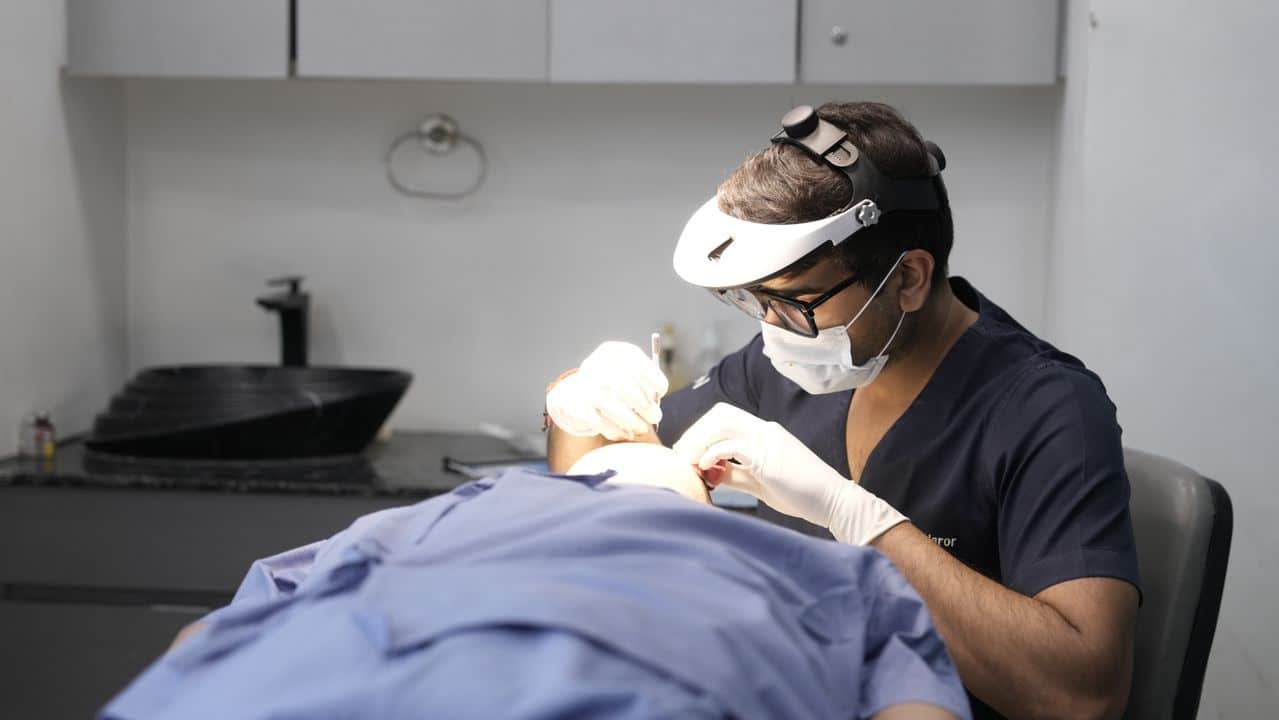
UK vs Turkey Hair Transplant: Cost, Risks and How to Choose
Tempted by a Turkish package? Weigh a UK vs Turkey hair transplant on real cost, ghost surgery risk, aftercare and the questions to ask a clinic.
Gender-Affirming Hair Restoration: An Integrated Surgical Approach
Rounding a masculine hairline takes careful design. Learn how gender-affirming hair restoration uses fine FUE grafts for a soft, natural result.